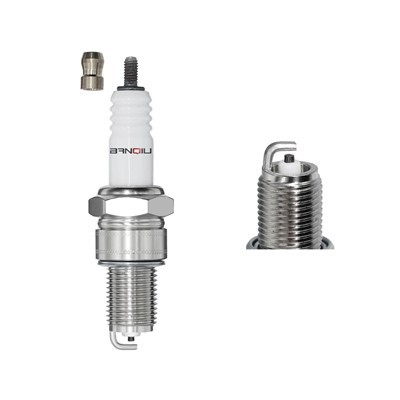
Hey there, fellow car enthusiasts! I'm a supplier of spark plugs for CNG cars, and I'm super stoked to dive into the nitty - gritty of how the spark plug firing order works in a CNG car.
First off, let's quickly understand what CNG is. Compressed Natural Gas (CNG) is a clean - burning alternative fuel. It's got a lot going for it, like being more eco - friendly and often more cost - effective than gasoline. But just like any fuel, it needs a proper ignition system to work its magic in an engine, and that's where spark plugs come in.
The Basics of Spark Plugs in a CNG Car
Spark plugs are like the little matchsticks of your car's engine. They create the spark that ignites the air - fuel mixture in the combustion chamber. In a CNG car, this is crucial because CNG has different combustion characteristics compared to gasoline.
CNG has a higher octane rating, which means it can withstand higher compression ratios without pre - igniting. This allows CNG engines to run at higher compression ratios, which in turn can lead to better fuel efficiency and power output. But to make all this happen, the spark plugs need to fire at the right time.
How the Firing Order is Determined
The firing order in an engine is basically the sequence in which the spark plugs fire. It's not just a random order; it's carefully designed to ensure smooth engine operation. In a multi - cylinder engine, if the firing order is off, the engine can run rough, lose power, and even cause damage over time.
The firing order is determined by the engine's design. Factors like the number of cylinders, the crankshaft design, and the valve timing all play a role. For example, in a 4 - cylinder engine, a common firing order is 1 - 3 - 4 - 2. This means that the spark plug in cylinder 1 fires first, followed by cylinder 3, then cylinder 4, and finally cylinder 2.
Why is this order important? Well, it helps balance the engine's power strokes. When one cylinder is on its power stroke (the part where the expanding gases push the piston down), the other cylinders are in different stages of the four - stroke cycle (intake, compression, power, and exhaust). A proper firing order ensures that the power strokes are evenly spaced, which results in a smooth - running engine.
CNG - Specific Considerations
In a CNG car, there are a few extra things to keep in mind when it comes to the firing order. CNG burns a bit slower than gasoline, so the spark timing might need to be adjusted slightly. This is often done through the engine's electronic control unit (ECU).
The ECU monitors various engine parameters like engine speed, load, and temperature, and it adjusts the spark timing accordingly. For example, at higher engine speeds, the spark might need to occur a bit earlier to ensure that the CNG has enough time to burn completely during the power stroke.


The Role of Good Quality Spark Plugs
Now, I'm a spark plug supplier, so I can't stress enough how important it is to use good quality spark plugs in a CNG car. The right spark plug can make a huge difference in engine performance.
We offer some great options, like the Nickel Spark Plug LMAR9D - J 1633. This spark plug is designed to handle the unique combustion characteristics of CNG. It has a good heat range, which means it can dissipate heat effectively, preventing over - heating and pre - ignition.
Another great choice is the Nickel Spark Plug BC6ES 3312. It's made with high - quality materials that can withstand the high temperatures and pressures in a CNG engine. This helps ensure a consistent spark and reliable ignition.
And if you're looking for a spark plug that offers great value for money, the Nickel Spark Plug TR55 1048 is a solid option. It provides a strong spark and is built to last, which is essential for a CNG car that's going to be used regularly.
How the Firing Order Affects Engine Performance
A correct firing order is directly related to engine performance. When the spark plugs fire in the right sequence, the engine runs smoothly, with less vibration. This means a more comfortable ride for you and less wear and tear on the engine components.
It also affects fuel efficiency. If the firing order is correct, the CNG is burned more efficiently, which means you'll get more miles per gallon (or equivalent in CNG). On the other hand, if the firing order is off, the engine might not burn the CNG completely, leading to wasted fuel and higher emissions.
Maintaining the Firing Order
To keep the firing order working properly, regular maintenance is key. This includes checking and replacing the spark plugs at the recommended intervals. Over time, spark plugs can wear out, and their performance can degrade. This can lead to misfires, which can disrupt the firing order.
It's also important to check the ignition wires. Faulty ignition wires can cause the spark to not reach the spark plugs properly, which can also mess up the firing order. Make sure the wires are in good condition and properly connected.
Conclusion
So, there you have it! That's how the spark plug firing order works in a CNG car. It's a complex but crucial part of the engine's operation. Using the right spark plugs, like the ones we offer, and maintaining the firing order through regular maintenance can make a big difference in your CNG car's performance.
If you're in the market for high - quality spark plugs for your CNG car, don't hesitate to reach out. We're here to help you find the perfect spark plugs for your needs. Whether you're a professional mechanic or a car owner looking to do some DIY maintenance, we've got you covered. Let's get your CNG car running at its best!
References
- Heywood, J. B. (1988). Internal Combustion Engine Fundamentals. McGraw - Hill.
- Stone, R. (2012). Introduction to Internal Combustion Engines. Pearson Education.